Wednesday, June 29, 2011

Sacred Spaces


“The corrosive eyes of time have not stared these ancient walls down…as if to say there are places in the world where beauty remains hidden and miraculously intact.  This transcendent space where one leaves one world and enters another…”
      ~Terry Tempest Williams, Finding Beauty in a Broken World


I’ve been in such spaces where I’ve felt I had entered into another world. As a child, I created one of those places with my best friend, Sandy. She lived across the street from me in a boisterous Scotch Catholic houseful of six siblings. I was an only child, and a Lutheran. One of our favorite activities was to act out the Catholic mass on the steps of a Methodist Church on the street corner two doors from Sandy’s house. Following Sandy’s lead, I would bobby-pin a white doily to my head, move my left hand up, down, and across my chest in the shape of a cross, and kneel on the church’s cement steps. I can still remember the feel of the cold wrought iron railing I grasped as I knelt and how the concrete made little dents in my knees.  I don’t know what drew me to this imaginative play, but I suspect it was a desire for something predictable and tangible as my child mind tried to make sense of the world. It was probably that same confusion that pulled me to attend real church services even when my parents didn’t.

Nearly twenty years later, I found a spiritual home among Friends, my faith and practice having shifted to Quakerism’s emphasis on inward experience without outward rites and ceremonies. I embraced the Quaker view that all of life is sacred, each day is of equal importance, and the Divine can be found in any place.  I’ve encountered that essence that I call God many times and in many places where I’ve gathered with others in the silence, quieting ourselves and opening to it.

Rivers, mountains, forests, and oceans also are like sanctuaries for me.  Sunrises and sunsets, thunderstorms and lightning, wildflowers bursting through cracks in rocks, kelp and seaweed swirling with the rhythm of the tides and currents, tree roots gripping the ground to resist wind and roaring floods­—these are forces that also open my heart and quiet my mind to hear and feel God’s presence. The voice of wisdom and love that I listen for often is in the breeze that lifts tree branches and rustles the grass. A favorite rocky point I visit regularly, shaped by eons of wind, rain, and crashing waves that have moved boulders and gnarled pines, manifests the power and strength I lean on. For me, Presence is in the smell of decay and new growth, of wet mineral and dried grass.
                                                                                           
After thirty years of Quaker worship as well as my experience of Spirit in nature, I hadn’t expected to be so drawn to a Catholic church in Mexico. My husband and I have visited San Miguel de Allende in Guanajuato, Mexico several times and have worshipped there with Quakers in the home of an expatriate. At every visit, though, I’ve also been drawn to La Parroquia, the parish church in the main square. Church after church was built on this same site beginning in the 16th century. Around 1880, a self-taught mestizo architect, Don Zeferino Gutiérrez, was hired to build a new church façade. His inspiration came from postcard images of the great Gothic European cathedrals like Notre Dame. The result is a mass of pink columns, railings, windows, spires, and steeples.

It’s been a few years since I’ve been to La Parroquia, but I can easily recall its welcoming sacredness. It’s always cool inside the church’s concrete walls and quiet as the tile floor mutes footsteps. The scent of melting wax wafts from candles flickering around statues at stations of the cross, mixing with gladiolas and lilies on the altar,  freshly laundered shirts and dresses, the gel on adolescent boys’ hair. The benches I've sat on have been worn to a honey glow by countless generations of toddlers, grandmothers, and young couples, much like those pausing in the church every time I’ve stopped in. The back of the pew in front of me had been smoothed and darkened by hands that have clutched it, just as I’ve done, compelled by some force to lower my body to my knees.

Thousands, maybe millions, of people have entered this same space with the intention to focus on divinity. I wonder how much incense and how many candles have burned here. How many words of adoration, thanksgiving, forgiveness, grief, and joy have been offered up over the church’s 500 years of confessions, funerals, weddings, baptisms, and prayers? How many hymns have been sung, rosaries prayed, chords played on the massive pipe organ in the far reaches of the ceiling?  Surely their presence has changed the molecules in the stone columns and the spires, in the air.

Sarah Hoggatt described on her blog (http://walkingthesea.blogspot.com/2011_04_01_archive.html) a similar experience this spring in England at Jordans Friends Meeting. 
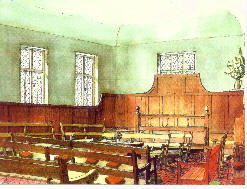
Jordans Friends Meeting
Painting by Paul Garland

Built in 1688, the Meeting House is pictured in “The Presence in the Midst,” a well-known 1916 painting by James Doyle Penrose which portrays a meeting for worship of earlier years there with Jesus standing among Friends in the meeting. Here’s how Sarah wrote about sitting with other Young Adult Friends at Jordans in April 2011:

“Being one of the oldest meeting houses, just think of all the words those walls have heard.  At the time we were there, there was a talk going on in another room about how a building is infused with what has gone on within it, that there is an unseen memory.  What kind of memory does Jordans Friends Meeting have?  To me, it felt sacred, hallowed, as if I was entering into a larger circle of living fellowship beyond what my hands could grasp.”

I’ve only scratched the surface of the study of Quantum Physics, but my limited understanding of its theories support my belief that certain spaces have been altered permanently as a result of years, decades, centuries of people going to them with an openness to the Divine. How else to explain the sacred connection I’ve felt (and Sarah did, too) with those who’ve gone to La Parroquia and Jordans Friends Meeting for solace or guidance; who’ve arrived in fear, in hope, in contrition. Isn’t that how we all meet Spirit, wherever we go? I’m content with the amount of understanding I have about how these changes happen; it’s a mystery I don’t have to solve, a question that doesn’t have to be answered. I can just experience it.

Perhaps I’ve come full circle back to my childhood yearning for “transcendent space where one leaves one world and enters another.” I’m grateful there are places that call to us in this way, that invite us to open ourselves to Divine love and grace and are changed by our seeking. Those transcendent spaces remind me I’m not alone; I’m connected with those who have preceded me, my journey mingled with theirs. 

Monday, June 13, 2011

A Modest Genre

Lake Chelan by David Ansley

Last week, I attended a workshop on The Personal Essay  led by Ana Maria Spagna (http://www.anamariaspagna.blogspot.com/). One of the prompts she gave us resulted in the following essay.


A Modest Genre

This morning I watched the lake change from green waves, to black glass, and now to gray ripples. According to the dictionary on my laptop, a ripple is a small wave or series of waves on the surface of water.  I looked the word up as I started to write on this last morning of a workshop on the personal essay. I’m two hundred miles from home, in a cabin at the end of a long lake in the mountains, out of reach of the phone, the Internet, and my well-worn dictionary and thesaurus that I turn to in search of different words to say the things that I want to say, to write the things that it seems so many writers already have written.  I’ve spent the past four days with six other women, other women like me diving into the depths of memories, emotions, and dreams to bring those series of waves to the surface.

This morning I watched the lake change from green waves, to black glass, and now to gray ripples. In physics, my laptop dictionary tells me, ripples are small, periodic, usually undesirable variations in electrical voltage. Such ripples have surged through our little group in the cabin in the mountains, at the end of the lake, as we’ve approached, avoided, and re-approached losses, fears, regrets, mysteries, and discoveries. One woman said a teacher once told her all writing is about grief. Though we protested and recalled stories of joy and hope and redemption, we’ve all felt those undesirable variations in electrical voltage as grieving words coursed through our fingertips, as tears streamed down our cheeks.

This morning I watched the lake change from green waves, to black glass, and now to gray ripples. I’m relieved the boat that will start me on my journey home will be carried on these small waves, rather than the white caps that rollicked across the lake yesterday. In the coming days and months, there likely will be plenty more ripples of the undesirable jolt type as I study this form first described by that sixteenth-century Frenchman, Michel de Montaigne. He derived the name essai from a French verb that suggests experimenting, testing, and weighing out; so similar to my spiritual journey. Essayist Sara Levin claims, “The essay is a modest genre. It doesn’t mean to change the world. Instead it says – let me tell you what happened to me.” All these centuries since Montaigne, many of us still compose essays to make sense of life, or at least some wedge of it.

This morning I watched the lake change from green waves, to black glass, and now to gray ripples. My dictionary offers another definition of ripple—the particular feeling or effect that spreads through or to someone, as in her words set off a ripple of insight within her readers. This group of writers will leave today on this rippling lake, recommitted to experimenting, testing, and weighing out to make sense of slices of life, packing new tools to tell others what happened to us.  Our words may not mean to change the world, but they will.

Thursday, May 26, 2011

Writing as a Path to Spirit


When Carol Sexton, Arts and Spirituality teacher at Pendle Hill, invited me to give a lecture at the Quaker conference and retreat center, I was thrilled and honored. This year’s “Way of the Artist” Speakers Series featured ten artists—painters, writers, musicians, photographers, storytellers, poets, actors—“who have followed a deep call to the creative life and discovered the power of the arts for prayer, spiritual practice, healing, teaching, building community, and creating social change.”  On May 17, I spoke about “Writing as a Path to Spirit.”  I’ve excerpted the lecture here; you can listen to the entire talk at http://www.pendlehill.org/images/lectures/20110517_Writing_as_a_Path_to_Spirit.mp3.

~  ~   ~  ~  ~  ~  ~


Writing as a Path 
to Spirit

 Words are powerful; they come back to us and draw us closer to Spirit. Think of a time you were touched by God through words on a page. Think of that time, and remember how God moved in you through those words.*

As a child, the excitement I felt every fall when it was time to buy new pencils, pens, and notebooks for school was an early clue that I might someday be drawn to creating with words. Still today, I can’t walk past an office supply store without stopping in to flip through blank journals and scribble on those little scratch pads beside the pens on display.

I developed an appreciation for people’s stories from my mom:  first, as a fifth-grader, reading her weekly “Bellmont News” column, with its reports of who visited whom, that was published in a small town newspaper in Southern Illinois; later, sitting beside her in the studio of the local radio station while she discussed recent events and interviewed folks from our community; and finally, through her news stories and personal essays in the daily newspaper.

Years later, when I became a nurse, I again listened to stories. In hospital rooms, clinics, and homes I experienced an uncommon intimacy as patients shared their fears, hopes, grief, and pain. I knew my listening supported healing; it also fed my love of narrative.

Most of my nursing practice has been in public health.  I felt called to that specialty’s priority of promoting health for all and for being a safety net for communities and people who typically are under-served. In the early 1990s, however, I discovered that concern about the bottom line was gaining greater influence over public health policy and practice. At the same time, I felt helpless and overwhelmed by my caseload’s never-ending stream of pregnant teens and young women ill-equipped to deal with parenting complicated by poverty, drug and alcohol abuse, or domestic violence. I admitted to myself that I no longer approached my work with the passion and compassion I once had. For me, that was a crisis.

Just as my disillusionment was rising, my family was feeling squeezed by Middle America’s compulsion to move faster, consume more, and question less. We embarked on a sojourn in the remote mountain community of Stehekin, Washington to re-evaluate priorities.

There, nestled in a valley surrounded by the craggy peaks of the North Cascades, with no phones nor television, and only 80 neighbors, I sought to reclaim the spiritual footing I’d lost.  Two years later, I left Stehekin with more clarity about new directions in my work, a commitment to devote more time to writing, and ample material for personal essays. That journey is the focus of the memoir I’m working on.

Still preferring a remote community, we moved from Stehekin to a rural island in Puget Sound. I figured out how to do the parts of nursing I enjoyed most and developed a public health consultation practice. In October 2000, instead of attending the annual fall public health conference as I usually did, I enrolled in a week-long writing course led by Tom Mullen at Pendle Hill. During the workshop, we discussed how to fit writing into our lives. I realized a number of my consulting contracts would be completed by the end of the year, and I saw an opening to try a new schedule. Why not fit nursing work around writing, instead of the other way around?   I announced to my fifteen workshop classmates that in January 2001 I would start a new job.  Since then, the desire to promote health and healing that drew me to nursing in my twenties has found expression more in my writing.

What I hadn’t anticipated when I took this “job,” was just how much writing would feed me spiritually. Vinita Hampton Wright is someone whose thinking about art and spirituality speaks to me. She explains in The Soul Tells a Story­—Engaging Creativity with Spirituality in the Writing Life:

“I have become a more spiritual person because I write. The creative process is a spiritual one and when we receive it as such, it deepens our gifts and edifies us in general. To write true stories, I must encounter truth. If I truly open my eyes and express in words what I have seen, then I will have participated in a spiritual act. I receive the vision from beyond myself, and I express it through who I am. This is God at work.”

Wright's words describe well my experience writing Hands at Work. While not explicitly Quaker, this book grew from my understanding of the Quaker testimonies of simplicity and equality and from my belief in that of God in everyone and of the importance and value of everyone’s story. Listening to and writing the stories ministered to me in my own seeking to do Spirit-led and Spirit-filled work. I know it ministered to the people I interviewed—they told me how they appreciated being watched and listened to as they worked. And I know it has ministered to others who have read the stories and looked at the images and felt inspired, challenged, or affirmed in their own work.

Every time I sit down to write is an act of faith. I typically come to my writing with questions, rather than answers. Through the writing, I tap into a wisdom that is beyond me. Wright claims, “It’s easier to trust the creative process when you also trust that a greater force is somehow guiding that process.” She refers to the faith required to engage creativity with spirituality as “submitting to a divine process that is beyond you.”

Wright claims that in the creative process, the only control lies in the mastery of one’s craft. “Give up the illusion that you’re in charge,” she says. “The best you can do is develop your gifts with all the strength and mind and heart you have.” Garth Stein, author of The Art of Racing in the Rain, also urges building skill.  “We have to learn to be good technicians of the craft,” he says. “We’re not just telling stories; we’re transforming people.”

As a writer who experiences this craft as a path to Spirit, it seems fitting that much of the language of the creative process is common to the spiritual life. Wright’s term—submit— is the same one used for the action of sending work out for publication. Release is the first presentation of a work to the public, such as a book release or a CD release. Many artists call celebrations of their work openings.  And in order to not just tell stories, but transform people, we have to practice.

I welcome your thoughts about how writing or other creative work serves as a path to Spirit for you.  I leave you with a few queries to consider now and in the days ahead.

How have creativity and spirituality been linked in your experience?

What characteristics of creativity do you recognize in your life?

What spiritual practices do you already know of, or use, that might apply well to creative work?

What is your next step in being faithful to creative work you’ve been called to and/or to support someone you know to be faithful to a call to creative work?

*With appreciation to Christine Hall of Whidbey Island Worship Group who shared this reflection when she introduced plans to start a School of the Spirit program in the West.


Tuesday, May 10, 2011

No Cause for Celebration - Yet


I froze when I saw the bold, large headline on the New York Times website – “Osama bin Laden Dead.” I called out to my husband and read it out loud, disbelief in my voice. As I read through the story that bin Laden had been found in Pakistan and killed by US special forces, my stomach soured.  I searched my heart for feelings of relief—relief that this man our nation has feared since long before Sept. 11, 2001could no longer wield influence. I tried to imagine how I would feel if I were a family member of someone killed in the attacks on Sept. 11, or if someone close to me had been killed in the wars in Iraq and Afghanistan. Would bin Laden’s death provide them some kind of closure?

But I felt no relief, and certainly no joy. Instead, all that welled up was grief – for the nearly three thousand lives lost on Sept. 11, for the tens of thousands of lives lost in Afghanistan and Iraq, and the trillion dollars spent so far by the U.S. to end terrorism.

In the following days, as I read about celebrations around the U.S., I felt alone in my sadness. In the comfort of my rural, remote community, with no threats to my well-being, I re-examined my commitment to non-violence. Although my heartache was real, I judged my rejection of killing another human being, even one who had brought so much violence to thousands of people for decades, as naïve. Yet I couldn’t shake the darkness that I sensed as I read justification for bin Laden’s murder.

Since the news of bin Laden’s death, I’ve read, prayed, and talked with others to find clarity about my opposition to my government’s actions.  One friend recommended the site of Sojourners Magazine and its “God’s Politics Blog.” There, Jim Wallis posted some helpful queries: 

·        How do we best respond to evil and those who perpetrate it?
·        What have we learned in the last 10 years about what truly is the best answer to the violence of terrorism?
·        How do we change the conditions that have allowed terrorists to pull others into their agenda?


An e-mail from the American Friends Service Committee (AFSC) directed me to a discussion on their Facebook page about bin Laden’s killing. And an essay by Kathy Kelley of Voices for Creative Nonviolence (http://vcnv.org/) presented sobering facts about the people and the place our country has been fighting for ten years.  She writes in“Beyond Retaliation”

“They live in a country where 850 children die every day, a country which the UN has termed the worst country in the world into which a child can be born, where the average life expectancy is 42 years of age. The UN says that 7.4 million Afghans live with hunger and fear of starvation, while millions more rely on food help, and one in five children die before the age of five. Each week, the U.S. taxpayers spend two billion dollars to continue the war in Afghanistan.”
I also turned to the Friends Committee on National Legislation (FCNL) to help me discern my beliefs about the actions of my government. Once again, there I found grounded, Spirit-centered wisdom as well as tools for action that strengthen my commitment to nonviolence and support to speak my truth.
Jonathan Evans, FCNL Legislative Representative, Foreign Policy, questioned why he, too, felt no joy or relief at the news of bin Laden’s assassination. He spoke my mind on the FCNL blog:
I believe deeply that war is not, and never has been, the answer to terrorism. My Quaker faith leads me to the conclusion that nonviolence is the only way to promote peace and justice. Jesus taught us to love our enemies. He did not teach (or ask) us to kill them. That basic teaching is as relevant today as it was two thousand years ago. In short, we are called to witness to the spirit of love that takes away the occasion for war. We are called to seek that of God in every person, even when that person perpetrates evil in the world.”
Posted on another page of the FCNL website was an action alert (http://fcnl.org/action/alert/2011/lam0502/) for those who viewed bin Laden’s murder not as a success but  “a failure of imagination and of political will that led to answering violence with more violence.” With a few clicks, I drafted messages to both of my senators and my representative, expressing my view that killing bin Laden and more violence are not the answers. With the help of FCNL, I listed alternatives to violence that I believe will promote peace:
·        begin a significant withdrawal of U.S. troops from Afghanistan
·        halt offensive operations against the Taliban
·        engage Afghan parties and Afghanistan's neighbors in negotiating peace
·        channel U.S. development aid for reconstruction through Afghan, multilateral, and other civilian humanitarian organizations.

Now, as the shock has faded, and I’ve felt buoyed by evidence of many others who mourn this act of violence, I’m starting to see the potential for changed approaches and opportunities.  Jim Wallis suggests, “The death of Osama bin Laden could be a turning point in our ability to both resist evil and seek good, to turn away from the logic of both terrorism and war, and, as the Bible says, to find the things ‘that make for peace.’” Jonathan Evans also believes in the possibility of a turning point  “…that takes us in the direction of realizing sooner rather than later two FCNL objectives: the removal of U.S. military bases and combat troops from Afghanistan; and diplomatic efforts to reach a negotiated settlement in Afghanistan. When accomplished, both will be worth celebrating.”

David R. Woolley, a Friend from Minneapolis, is already thinking of how to celebrate. According to his post at Quaker Universalist Voice, he’s promoting an idea for how Friends might turn this year’s tenth anniversary of 9/11 into “…an opportunity for honest dialog, mutual forgiveness, and reconciliation.”  Here’s what he envisions:

“9/11 this year is a Sunday. What if Quaker meetings were to pair up with mosques and hold joint worship services? What if Friends were to attend Friday prayers at a mosque, and Muslims were to attend worship at a Quaker meeting on Sunday?  It would make for a weekend of interfaith worship, fellowship, and learning, from 9-9-11 to 9-11-11…If this idea could spread beyond Quaker meetings, with HUNDREDS of partnerships forming between Friends meetings, other Christian churches, synagogues, and mosques all over America, it would be too big a story for the mainstream media to ignore. Maybe it could begin to turn the tide.”

I pray, and believe, that healing comes through nonviolent work toward justice. I’m grateful for Jonathan, Kathy, Jim, David, and many others like them who are leading the way.  Quaker Universalist Conversations

Tuesday, April 19, 2011

Time-Simply


Winter’s rains have barely ended; spring blossoms are just nudging their way through the cold soil; and already it’s started—the predictable, annual speeding up of the clock. I can feel an energy in the air, like a child wildly cranking a jack-in-the-box, as if to make up for the past few months of shorter days. As much as I welcome the longer hours of sunlight and the warmth and golden glow of the sun, I’m resisting the accelerating tempo.

It’s not as though I hide away during the winter. I still go to my job as a school nurse, work every day at my writing desk, walk the dog, gather with friends, attend Meeting, carry out household chores, and fulfill my commitments to various organizations. But I do take the season’s cold and dark as permission to burrow under my comforter, sip my tea more slowly, and inhale more deeply. Then, every April, I notice a shift pushing me, like commuters elbowing themselves into a New York subway at rush hour, to squeeze more activity into my already-full life.

This year I’m considering how my springtime ritual of scheduling every minute of my day conflicts with the Quaker testimony of simplicity. Although my possessions could be whittled down, I’m not tempted to acquire more stuff nearly so much as to fill my days doing more and more. In Hunting for Hope, essayist Scott Russell Sanders summarizes well a growing yearning for me—

“…the richness of a gathered and deliberate life, letting one’s belongings and commitments be few in number and high in quality.” 

Thomas Kelly understood the breadth of the simplicity testimony. His words from over seventy years ago in A Testament of Devotion sound as though they were written yesterday. “Quaker simplicity needs to be expressed not merely in dress and architecture and the height of tombstones… Too many of us have too many irons in the fire…pulled and hauled breathlessly along by an over-burdened program of good committees and good undertakings.”

I can hear myself panting as I glance at my calendar. For years I carried a spiral-bound date book that fit in my jacket pocket. Black ink scrawls of meetings, to do lists, and tasks filled each day’s square.  Now, I track where I’m supposed to be and what I have to do on a sleek, hand-held computer I can synchronize with my laptop. As I scroll through the days this week, nearly every box is filled with strips of color for different facets of my life--bright green for work dominates the boxes, along with blue and turquoise for home, family, and Meeting obligations. Most days, very little white space remains. My computer screen glows with evidence I’ve not achieved that gathered and balanced life Sanders refers to.

Simplifying my life isn’t a new challenge for me, and it’s not that I haven’t made some progress. My schedule now reflects better than ever my priorities for regular meditation, periods of solitude, and writing. But I still struggle with Kelly’s guidance that “… a life becomes simplified when dominated by faithfulness to a few concerns.” His words echo those of Caroline Stephen, whose Quaker Strongholds appeared in 1890.  She wrote, “In life, as in art, whatever does not help, hinders. All that is superfluous to the main object of life must be cleared away…a severe pruning away of redundance.”

This year, rather than unconsciously picking up my pace or pruning without thought, I’m looking deeper into the roots of my crowded calendar. I’ve developed several theories about why an empty date book raises anxiety, like groping through a dark, narrowing tunnel, rather than the sense of boundlessness of a jet stream streaking silently across the sky.  Years of striving to please others by doing, and being efficient, have kept me rushing from one task to another like a hummingbird darting to and from the feeder. Deaths of family and friends sobered my childhood and young adulthood and left me keenly aware of the brevity of life and suspicious of the promise of tomorrow and next year. For much of my life, the precision and certainty of a full calendar has given me a sense of worth and an illusion of control. It’s protected me from the unknown and comforted me like a polar fleece blanket hugging my shoulders. Lately, though, clicking open my calendar has felt less like solace and more like my Midwest childhood memories of walking out of an air-conditioned building into the wall of humidity on an August day.

While I’ve gotten better at quieting myself enough to listen for those few concerns—those main objects of life— that God calls me to, one of my challenges to Spirit-led pruning is believing that the value of those callings isn’t measured by quantity or speed. This April, I’m seeking the simplicity of unfilled lines in my calendar. I want my breathlessness to come from walks on the beach when the sun unexpectedly breaks through the clouds. Rather than tearing through errands, I want a schedule that allows for trips to the village on my bicycle rather than in the car, unhurried chats with neighbors at the grocery store, and a visit with an elderly friend. Instead of feeling guilty for not responding to the many needs of the planet, my country, my community, my family and friends, I’m committing to the few with which I can be fully, joyfully present, trusting that my own worth isn’t dependent on a jam-packed agenda. Perhaps this April and the coming months will find me closer to time—simply.

Photo credit:  http://newsworld11.blogspot.com/2010/10/when-do-we-turn-clocks-back-in-2010.html

Thursday, March 31, 2011

Libya and the Peace Testimony


Rarely have I doubted my commitment to the Peace Testimony of Friends.  I’m clear that violence is not the answer to hurts within a family, misunderstandings between neighbors, discord in a community, or conflicts between nations.  Many times in my life I’ve called for an end to U.S. military involvement throughout the world—most recently in Afghanistan and Iraq.

And now there is Libya.

Over dinner with friends recently, I was asked what I thought, as a pacifist, about the US decision to intervene. I admitted that in the first days of the rebellion, I had been persuaded that a military approach might be the best option following reports of Gaddafi’s escalation of violence when the US froze his regime’s assets and imposed an arms embargo. Memories of past genocide in Rwanda and Bosnia raised questions for me about a peaceful way to eliminate Gadaffi’s brutal tactics and protect innocent people from his military. Maybe the threat of this tyrant was so great for thousands of people in Libya that compassion mandated deadly intervention. Each morning I went online, hoping for news that the plan had succeeded, that Gadaffi had surrendered. Although I knew it was wrong, I was coming to believe that air strikes could bring a fast, decisive solution to a decades-old abuse of power. I couldn’t see an alternative.

In his address to the nation on March 28, President Obama spelled out why the U.S. felt compelled to join in military attacks after those first few days of diplomatic efforts. “In the face of the world's condemnation, Gaddafi chose to escalate his attacks, launching a military campaign against the Libyan people,” Obama said. “Innocent people were targeted for killing. Hospitals and ambulances were attacked. Journalists were arrested, sexually assaulted, and killed. Supplies of food and fuel were choked off. The water for hundreds of thousands of people in Misratah was shut off. Cities and towns were shelled, mosques destroyed, and apartment buildings reduced to rubble. Military jets and helicopter gunships were unleashed upon people who had no means to defend themselves against assault from the air.”

Who doesn’t want to end such violence and cruelty? And as quickly as possible?

This morning as I centered into worship, I uncovered my desire for a fast solution, recognizing the folly of such thinking­—we have only to look at our eight-year involvement in Iraq (and countless other places) to remember that military intervention does not yield a quick result. Nor is it this time. I realized I had accepted the common belief that anything other than military intervention is inaction. Seeking guidance for other ways to act, I went to the Friends Committee on National Legislation (FCNL) website. There I found the kind of grounded, Spirit-led response I believe we’re called to.

Reading their alternatives to violence, I regained my steadfast belief that war is not the answer. The tools they offer on their website spurred me to convey that conviction to my elected representative and to ask them to take these actions:

·        Urge a ceasefire.
·        Provide humanitarian aid.
·        Continue an arms embargo based in international law.
·        Follow up the already-enacted UN Security Council resolution that refers the Gaddafi government to the International Criminal Court to hold him accountable for actions he has taken against fellow citizens.

President Obama’s words and actions suggest to me that he also struggles with how to be an agent of peace in the world. While he has pushed for a military response, he continues to call for other ways to assist in the removal of Gaddafi. I see indications that he is aware of the illusion of quick solutions, military or otherwise.  At the end of his speech, the President urged us to not be afraid to act. “We recognize that … a diplomatic, humanitarian approach will take time and intense international engagement to be successful. We believe, however, it offers the best chance of limiting the loss of life and restoring a path toward peace and stability.”

I pray that our leaders will recognize that non-violence is action. This is what I think the Peace Testimony calls us to in Libya.

For more about why “War is Not the Answer,” visit:


Friday, March 18, 2011

Reconciling the Existence of Evil

My Quaker meeting’s continuing discussion of Marge Abbott’s To Be Broken and Tender focused recently on the book’s second section – Encountering the Seed.  There’s much to consider in this segment that reflects on “The Nature of God,” “The Light of Christ,” “That of God in Everyone,” and “Spiritual Maturity.” I continue to chew on one of the queries we considered:  How do you explain or reconcile within yourself the existence of evil in the world? (p. 202)

I was surprised—and relieved—to learn that several people in my Meeting who spoke during our discussion share my lack of belief in Evil. Contrary to the teachings of my Lutheran upbringing, I believe we all come into this world not as sinners, but as whole, loving beings, equipped to do and be love. And then we are broken­­—most by living in an imperfect world, some by the harmful effects of people who aren’t capable of care and love, many by circumstances such as poverty and oppression that challenge the Light within. Such brokenness separates us from the Divine, from the knowledge and experience of the mystery of being loved fully and irrevocably. That separation can lead to immoral, malevolent actions—the very definition of evil. As horrible as those acts can be, I don’t believe they are the work of an evil force or of evil people.  

I’ve been reluctant to share this view for fear of seeming naïve about some of life’s harsh realities or disrespectful of the suffering of so many around the world at the hands of people who commit atrocities. Yet, I’m not unaware of the evidence of cruelty, immorality, and harm. I’ve heard it in the stories of clients in my work in public health in the Midwest and the Pacific Northwest—women and children abused by husbands and lovers, fathers and mothers; refugees and immigrants denied health care and education; families without adequate food and housing. I’ve seen it in my travels to Nicaragua meeting banana workers poisoned by pesticides; driving through the burning debris of the Managua dump to play with children who live there with their families; learning of the decades of corrupt governments that stole funds from international aid organizations in the aftermath of earthquakes and hurricanes; acknowledging my own country’s terrorist acts of military support. I’ve listened to the stories of women in Nicaragua and Mexico and have heard from Friends working in Burundi of the horrors of unemployment, poverty, HIV infection, and tribal violence. And this week, I’ve watched and listened in horror and grief as reports from Japan of the earthquake and tsunami and their aftermath have filled all the media outlets.

It’s through my own experience of encountering the inexplicable, steadfast love of God for me that I’m convinced of God’s love for everyone and view the wrongdoing as the result of our brokenness, our separation from the ever-present Spirit that loves all. As I weep over stories of greed, deception, abuse, prejudice, and violence, I envision the Divine Presence doing the same—crying for the pain and suffering brought on by souls that have been lost, people whose connection to the great force of Love has been severed.

I know we’re called to work for justice, but I wrestle with how humanity can right these injustices.  I’m certain that demonizing those who commit despicable acts does not heal the deep wounds they suffer and cause.  I have faith that, ultimately, God’s love restores us to wholeness. Marge Abbott’s powerful teaching reminds us that it is in our brokenness and tenderness that we receive such love.